


Short answer: yes, they can, and I’ve seen it happen more times than most people expect.
Many homeowners assume that switching to an air mattress solves a bed bug problem. It doesn’t. Bed bugs are not attracted to the mattress material itself. They are attracted to you, specifically the carbon dioxide you exhale and the body heat you give off while you sleep.
What You Should Know About Bed Bugs and Air Mattresses
Here’s what you need to know about bed bugs and air mattresses:
What an Air Mattress Does NOT Stop
- Bed bugs are climbing up from the floor onto a mattress lying flat on the ground.
- Bed bugs crawl along bedding or sheets that touch the floor or walls.
- Bed bugs are hiding in the seams, folds, and valve area of the air mattress itself.
- Bed bugs in the surrounding room can find you while you sleep.
Why Air Mattresses Offer Slightly Less Habitat
- PVC and vinyl surfaces have fewer deep crevices than traditional fabric mattresses.
- There is no internal foam or batting for bugs to burrow into.
- Fewer layers mean fewer hiding spots on the mattress itself.
Where They Still Hang On
- Along the welded seams around the perimeter of the mattress.
- Around the inflation valve and nozzle area.
- In the folds created when the mattress is stored or deflated.
- In bedding, pillowcases, and blankets draped over the mattress.
Field note: In my experience, when someone is sleeping on an air mattress during an active infestation, the bugs simply travel up the bedding to reach them. The mattress type is almost irrelevant if the room itself is infested.
Where Do Bed Bugs Actually Live?
Most people assume bed bugs only live in mattresses. In my 15 years of inspections, that’s rarely the full picture. These insects hide anywhere they can stay close to a sleeping or resting host, and they can squeeze into a gap no thicker than a credit card.
Here’s where I find them most often:
1. On and Around the Bed
- Mattress seams, piping, and tags.
- Box spring seams and the fabric underneath.
- Cracks in the bed frame and headboard joints.
- Behind the headboard, if it’s mounted to the wall.
2. Bedroom Furniture and Fixtures
- Dresser drawer joints and the corners inside drawers.
- Nightstand cracks and underneath the nightstands.
- Under loose baseboards and along wall-to-floor gaps.
- Behind peeling or loose wallpaper.
- Inside electrical outlet plates (yes, really).
3. Soft Furnishings Beyond the Bedroom
- Couch cushion seams and the frame underneath.
- Folds in curtains and decorative drapes.
- Carpet edges near the tack strip.
4. Travel and Entry Points
- Luggage seams and inner pockets.
- Purses or bags should be set down in infested areas.
- Secondhand furniture, clothing, or cardboard boxes brought inside.
5. Hidden Structural Spots
- Wall voids and the junction where the wall meets the ceiling.
- Window and door frames.
- Under loose wall hangings and picture frames.
Pro tip from the field: I always tell homeowners to think less about “the bed” and more about “within six feet of where you sleep.” That’s the zone I inspect first. If the infestation is heavy, bed bugs spread from room to room fast.
How to Check Your Air Mattress for Bed Bugs
If you suspect bed bugs are sharing your sleeping space, do not wait. The sooner you catch an infestation, the easier it is to treat. Here is exactly how I would inspect an air mattress if I were walking into your home today.
What You Need Before You Start
- A flashlight (bright, narrow beam works best).
- A credit card or flat-edged tool to drag along seams.
- A magnifying glass, if available.
- A white sheet or paper towel is laid underneath to catch anything that falls.
Step-by-Step Inspection
- Strip all bedding first and inspect sheets, pillowcases, and blankets separately. Look for rust-coloured stains, tiny dark spots, or shed skins.
- Examine every seam on the mattress by running your finger and the edge of a credit card slowly along each welded seam. Bed bugs and their eggs love to tuck in right at the seam ridge.
- Check the inflation valve and nozzle area closely. This small recessed spot is one of the most overlooked hiding places on an air mattress.
- Inspect the underside of the mattress if it is elevated. Flip it carefully and check the bottom surface and any folds.
- Look at the floor directly beneath the mattress. Bed bugs often drop frass (tiny dark droppings) directly below their hiding spot.
- Move away from the mattress and check the floor, baseboards, and any furniture within 6 feet.
What You Are Looking For
- Live bugs (flat, oval, reddish-brown, roughly the size of an apple seed).
- Tiny white eggs or pale yellow shed skins in seam crevices.
- Rust or reddish-brown stains on the mattress surface or bedding.
- Dark pepper-like droppings along seams or on the floor below.
- A faint musty or sweet odour in the room.
Field note: I always do air mattress inspections at night with a flashlight. Bed bugs are nocturnal and much easier to spot when they are active. If you find even one live bug, treat the entire room, not just the mattress.
Can You Put a Bed Bug Encasement on an Air Mattress?
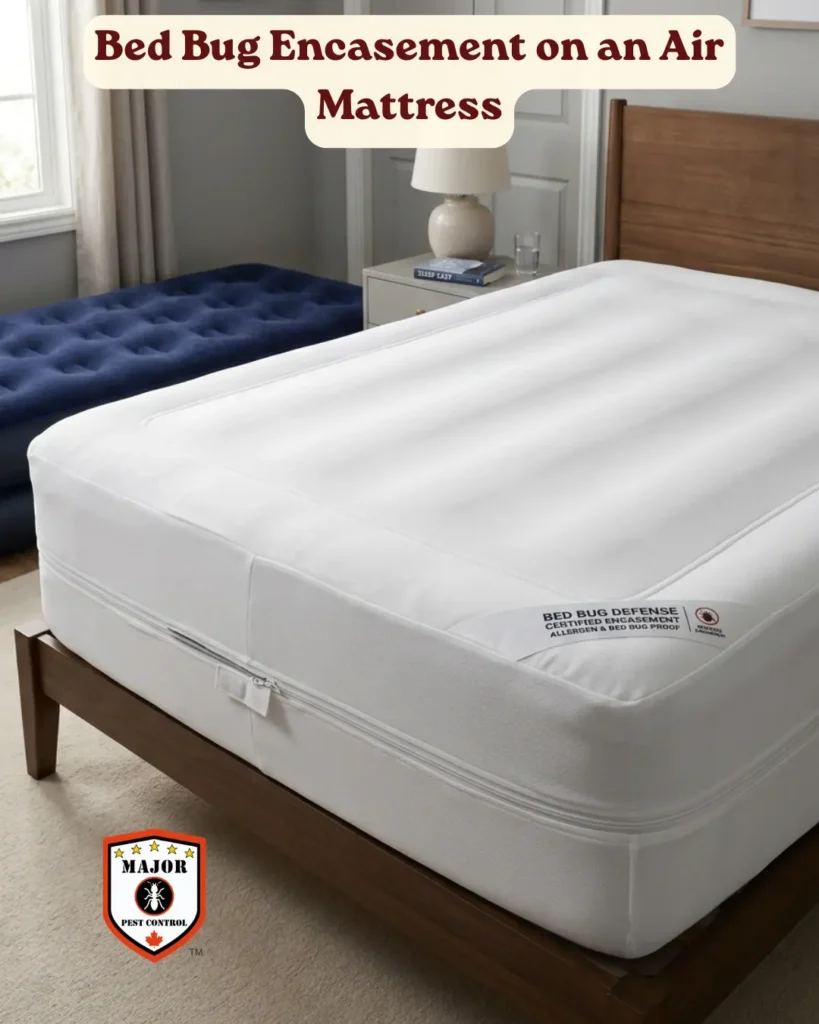
This is one of the most common questions I get from homeowners dealing with bed bugs while sleeping on an air mattress. The short answer is yes, but with some important conditions.
A standard bed bug encasement is designed for traditional foam or spring mattresses. It works by sealing the mattress completely so bugs cannot get in or out. The same principle applies to an air mattress, but there are a few things you need to know before you buy one.
What to Look for in an Air Mattress Encasement
- Make sure the encasement is sized to fit your specific air mattress dimensions.
- Look for a label that says “bed bug-proof” with a zipper guard or Velcro seal over the zipper teeth.
- The fabric should be tear-resistant since air mattresses shift and flex more than traditional mattresses.
- Avoid encasements made from thin plastic sheeting as they puncture easily and will not hold up.
What an Encasement Does
- Traps any bed bugs or eggs already on the mattress surface, seams, or valve area.
- Creates a smooth barrier that is harder for bugs to grip and climb.
- Makes future inspections easier since you can spot bugs and droppings on a flat surface more readily.
- Reduces the number of hiding spots available on the mattress itself.
What an Encasement Does Not Do
- It does not protect you from bed bugs living in the rest of the room.
- It does not replace professional treatment of the surrounding space.
- It does not kill any bugs already trapped inside; those bugs can survive for months without feeding.
- It is not a permanent fix if the infestation has spread beyond the mattress.
Field note: I always recommend encasements as part of a broader treatment plan, not as a standalone solution. Think of it as one layer of protection in a multi-step approach. If the room is not treated at the same time, the encasement is just slowing things down, not solving the problem.
One More Tip
Once you encase the mattress, leave the encasement on for at least 12 to 18 months. Bed bugs can survive a long time without a blood meal, especially in cooler Alberta temperatures. Removing the encasement too early risks releasing surviving bugs back into your sleeping area.
How to Prevent Bed Bugs from Getting on Your Air Mattress
Prevention is always easier than treatment. Whether you are using an air mattress as a temporary guest bed, a camping sleeping surface, or your primary sleep setup, these steps will significantly reduce your risk of a bed bug problem.
Be Careful Where You Use It
The single biggest risk factor for air mattress bed bug exposure is where the mattress has been used or stored. I have seen infestations traced back to a single overnight stay at an infested location.
- Never use an air mattress in a hotel, motel, or short-term rental without first inspecting the room.
- If you are visiting someone whose home has had a recent bed bug issue, keep your air mattress in a sealed bag until you are ready to use it.
- After any travel, inspect the mattress before bringing it back inside your home.
- Store your air mattress in a sealed storage bag between uses, not loose in a closet or under a bed.
Set It Up the Right Way
How and where you place your air mattress matters more than most people realize.
- Elevate the mattress on a frame whenever possible rather than placing it directly on the floor.
- Keep the mattress at least six inches away from walls, baseboards, and furniture.
- Avoid letting bedding, sheets, or blankets hang down and touch the floor; this creates a direct bridge for bugs to climb up.
- Place bed bug interceptor traps under each frame leg if you are using a frame.
Inspect Regularly
- Do a quick visual check of the seams and valve area every two weeks if the mattress is in regular use.
- After any guests have used the air mattress, inspect it before storing it away.
- Check the surrounding room periodically, especially baseboards, nearby furniture, and carpet edges.
When Travelling With an Air Mattress
- Pack it in a tightly sealed bag before and after every trip.
- When you arrive at your destination, place the mattress on a hard floor surface away from walls and inspect the room before inflating it.
- After returning home, unpack and inspect outdoors or in a garage before bringing it inside.
Field note: I always tell homeowners that bed bugs are hitchhikers. They do not jump or fly. They travel with luggage, clothing, furniture, and bedding. Controlling what comes into your home and where your mattress has been is the most effective prevention strategy you have.
A Quick Prevention Checklist
| Action | When to Do It |
| Inspect mattress seams and valve | Every 2 weeks during regular use |
| Wash all bedding on high heat | Every 1 to 2 weeks |
| Inspect room baseboards and furniture | Monthly |
| Inspect after guests use the mattress | Every time |
| Seal the mattress in a storage bag when not in use | Every time |
| Check the hotel or rental room before use | Every trip |
Air Mattress vs. Regular Mattress: Which Is Safer from Bed Bugs?
I get this question a lot, especially from homeowners who are mid-treatment and wondering whether switching to an air mattress will provide relief. Here is my honest answer as someone who has inspected thousands of beds across Edmonton and Alberta.
An air mattress is slightly less hospitable to bed bugs than a traditional mattress, but it is not a safe alternative during an active infestation. Let me break down exactly why.
Where a Traditional Mattress Gives Bed Bugs More to Work With
A standard foam or spring mattress provides bed bugs with far more hiding places. The layers of fabric, foam, batting, and internal spring pockets create dozens of deep, dark hiding spots that are nearly impossible to inspect thoroughly without tearing the mattress apart.
- Deep fabric seams that run the full perimeter of the mattress.
- Internal foam and batting layers where bugs can burrow and lay eggs.
- Quilted top panels with countless small pockets and folds.
- Fabric handles and vents on the sides that create additional entry points.
- Box springs underneath, which are often the most heavily infested part of the entire bed setup.
Where an Air Mattress Has the Edge
- Made from vinyl or PVC, which has no internal layers for bugs to burrow into.
- Fewer and shallower seams compared to a traditional mattress.
- A smooth surface makes visual inspection faster and easier.
- No box spring required, which eliminates one of the most common bed bug harborage sites.
- Easier to wipe down and treat the surface directly.
Where the Advantage Disappears
Despite those benefits, an air mattress loses its edge quickly in the following situations:
- When it is placed directly on the floor, bugs can reach it with almost no effort.
- When bedding hangs down and touches the walls or the floor, creating a climbing bridge.
- When the surrounding room is already infested, the bugs will simply travel to you regardless of what you sleep on.
- When the mattress is stored loosely without a sealed bag, picking up bugs between uses.
Side-by-Side Comparison
| Feature | Traditional Mattress | Air Mattress |
| Internal hiding spots | Many | None |
| Seam depth and complexity | Deep, fabric seams | Shallow, welded seams |
| Surface material | Fabric, quilting | Vinyl or PVC |
| Ease of inspection | Difficult | Easier |
| Box spring required | Often yes | No |
| Risk during active infestation | High | Moderate |
| Eliminates infestation risk | No | No |
Field note: Switching to an air mattress mid-infestation is one of the most common mistakes I see. Homeowners think the bugs will stay behind in the old mattress. What actually happens is the bugs follow the carbon dioxide and body heat to wherever you sleep next. If you move to a different room, you risk spreading the infestation to another part of the home.
My Recommendation
If you are in the middle of a bed bug infestation, do not focus on the mattress type. Focus on treating the entire room and calling a licensed pest control professional as quickly as possible. The mattress is rarely the whole problem.
When to Call a Professional for Bed Bugs on an Air Mattress
I want to be straightforward with you here. If you have found live bed bugs, eggs, or widespread staining on or around your air mattress, DIY treatment won’t cut it. Bed bugs are among the most difficult pests to eliminate without professional-grade tools and treatments, and Alberta homes present unique challenges due to our climate and the way heat moves through our buildings.
Call a licensed pest control professional right away if you notice any of the following:
- You have found live bugs or eggs anywhere in the room, not just on the mattress.
- You wake up with new bites every morning, despite washing your bedding.
- You have already tried over-the-counter sprays or heat treatments with no improvement.
- The infestation has spread to more than one room.
- You live in a multi-unit building or apartment where neighbouring units may also be affected.
Field note: Bed bugs in multi-unit buildings are a shared problem, not just a personal one. If you are in an apartment or condo, notify your property manager immediately. Treating one unit while neighbouring units remain untreated almost always leads to re-infestation within weeks.
At Major Pest Control, we use a combination of heat treatment, targeted chemical application, and follow-up inspections to make sure the job is done right. We back every treatment with our 30-day satisfaction guarantee. If you are not happy, you do not pay.
Frequently Asked Questions
Can bed bugs survive inside an inflated air mattress?
No. Bed bugs cannot live inside the air chamber of an inflated air mattress. They need to stay close to a food source and cannot survive inside a sealed, pressurized space. They hide on the outer surface, along seams, and near the valve, not inside the mattress itself.
Can bed bugs bite you through an air mattress?
No. Bed bugs cannot bite through the vinyl or PVC surface of an air mattress. They will crawl to exposed skin on your arms, neck, or face to feed. The mattress surface itself acts as a physical barrier.
How long can bed bugs live on an air mattress without feeding?
At normal Alberta room temperatures, bed bugs can survive for several weeks to several months without a blood meal. Cooler temperatures slow their metabolism and can extend their survival time. This is why encasements need to stay on for 12 to 18 months after treatment.
Should I throw out my air mattress if it has bed bugs?
Not necessarily. Because air mattresses have a smooth vinyl surface and no internal layers, they are easier to treat and encase than traditional mattresses. If the infestation is limited to the mattress surface and the room is treated professionally at the same time, the mattress can often be saved. If the mattress is old, heavily damaged, or infested with large numbers of bugs and eggs, replacement may be the more practical choice.
Can I use a steam cleaner on an air mattress to kill bed bugs?
Yes, with caution. Steam at temperatures above 49 degrees Celsius kills bed bugs and their eggs on contact. Hold the steamer nozzle close to each seam and the valve area, and move slowly. Avoid holding the steamer too close to any single spot for too long, as excessive heat can warp or damage the vinyl surface.
How much does bed bug treatment cost in Edmonton?
At Major Pest Control, bed bug control in Edmonton typically ranges from $695 to $995, depending on the size of the space and the severity of the infestation. Call us at 780-906-0911 for a free quote.
The Bottom Line
Lastly, if you suspect a bed bug infestation, don’t delay in contacting the experts, like Major Pest Control. They have entomologists on staff who know exactly how to eliminate bed bugs without spreading the infestation around. They have expert knowledge, professional tools, as well as various methods to eliminate bed bugs – guaranteed. Don’t live one more day with bugs – call today!

Reviewed By Jun Bukht, ACE, CWCO
Jun Bukht is the founder and owner of Major Pest Control. He holds the Associate Certified Entomologist (ACE) designation and is a Certified Wildlife Control Operator (CWCO), reflecting his commitment to science-based, humane pest management practices. Jun is the author of “Major Pest Control: Stories From the Trenches – A Homeowner’s Guide to Pest Control”, a best-selling book on KDP. His work and insights have been featured in television, radio, print, and online media across Alberta, where he discusses pest control, wildlife issues, and integrated pest management.